

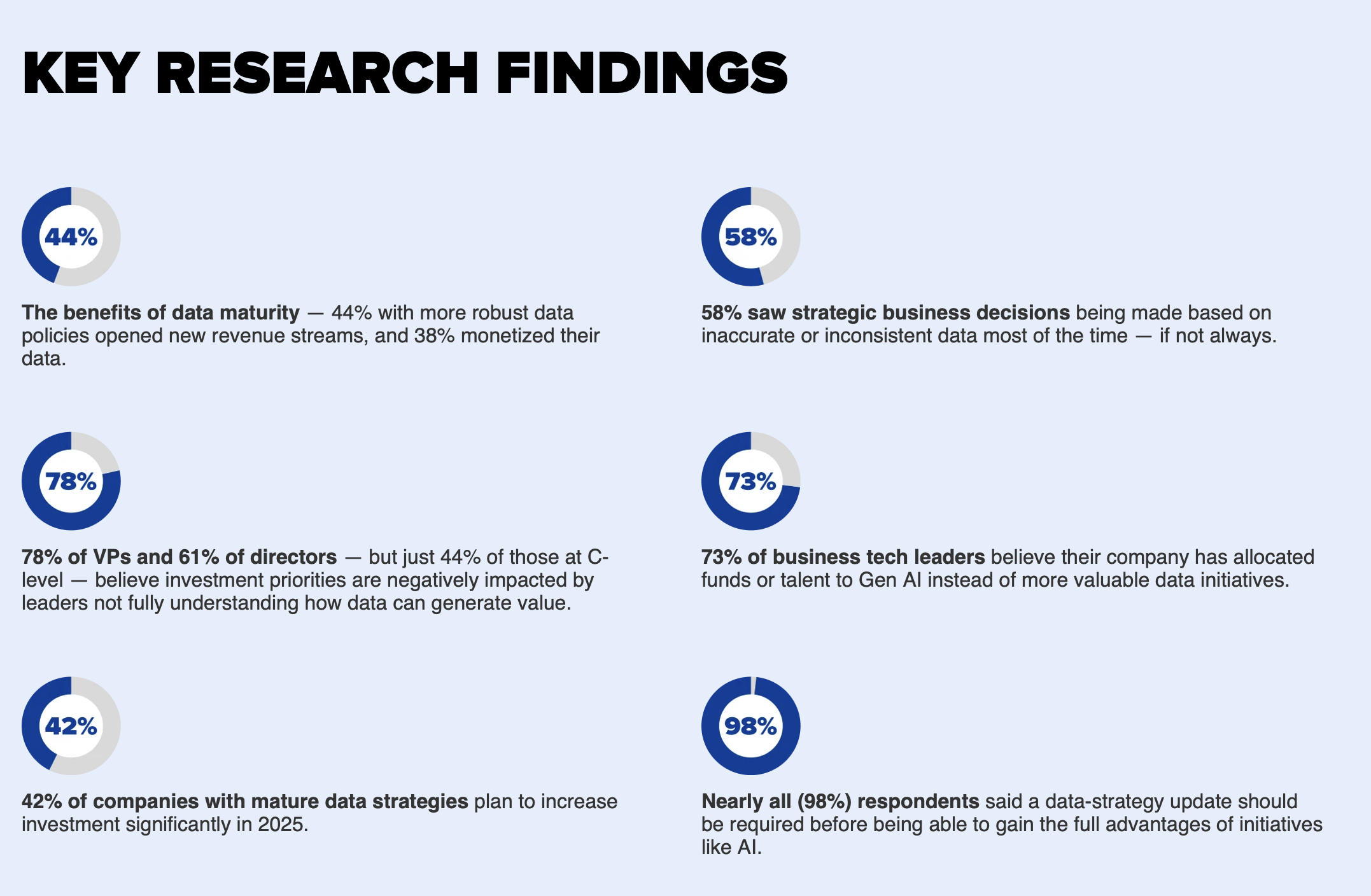
We are experiencing a significant gap between business leaders’ ambitious goals. The actual use of data is not meeting those aims[1]. Recent key findings from the industry highlight gen-AI may not be as valuable as anticipated. Data strategies are not meeting the needs of gen-AI. Other forms of AI are also affected.
Source: https://info.softserveinc.com/the-great-data-divide (access 01/05/2025)
Governmental data strategies have also led digital transformation with mix successes. The National Data Strategy has now been replaced by a A blueprint for modern digital government. The cost may be considered rather the value driver it brings. Digitising transactional services one project at a time is unlikely to support the automation and real-time services. Digital skills is a specialism rather than being democratised in every policy and service delivery.
data + data structure + mathematics + algorithms = AI
Organizations are starting to experience data issues experienced by AI, Machine Learning, and statistical research projects. Those projects focused first on a problem to solve and relied on a specific dataset. Businesses and organizations are being marketed tools that solve most problems a business experience. It is assuming sufficient data is available and in a format that promotes data consumption. The assumption is that complex mathematical concepts (statistics, probability, optimization, calculus) are implemented in learning algorithms and software products. The impacts of concepts should become understandable and responsibly used by a wide audience.
AI has now become a specialist software that is mainly referred as generative AI. Workforce productivity, innovation, multi-domain applications, as well as democratization of information and skills is being promised.

Achieving those objectives is challenging. It requires investing time and resources and relying on a sound data and information foundation. The concept of data now includes images, graphs, website content, reports, videos, and other types. Data and AI are converging as the same aim, to empower professionals using AI responsibly and augmenting their abilities. Agentic-AI is supposed to automate workforce tasks, reducing time spent prioritizing emails, or identifying suitable candidates for a position. Agentic-AI can generate code and develop applications. It is believed it can reduce the need to hire specialist software engineers. However, it increases exponentially technical debt and maintenance costs.
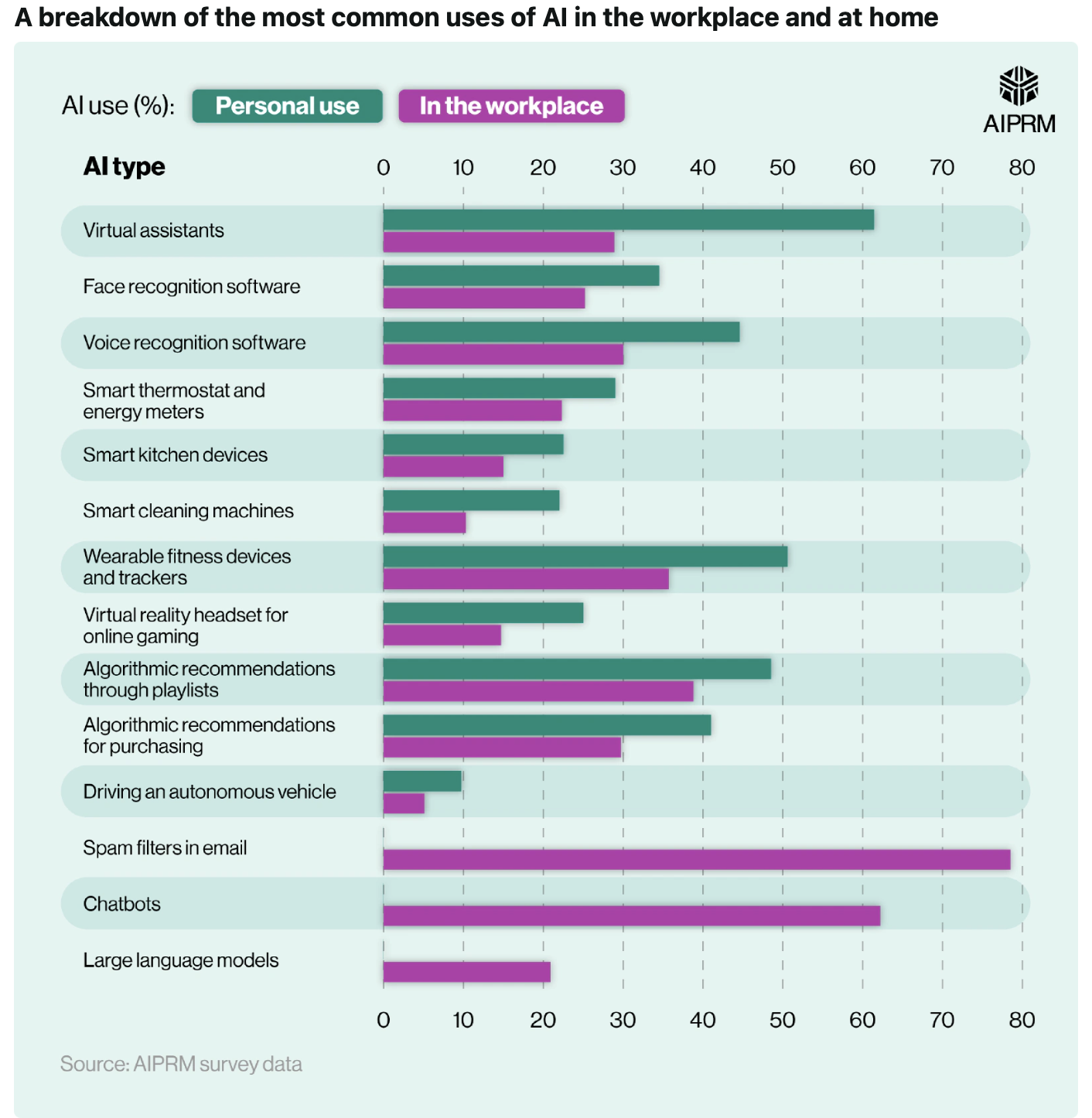
The Conversation discusses challenges around training data availability, regulations, automation and robotics. Specialist software have implemented AI for specific and well-defined tasks. These include recommenders, predictors, and filtering tools. Voice and face recognition have already been adopted by businesses and organizations (see image below [2]).
What are blockers to use of AI?
Not small enough
A specific and well-defined application of AI is likely to rely on specific training data. This data must be suitably curated. Evaluating the learning algorithms’ performance becomes easier. Assessing the model’s effectiveness is also easier to compute and analyze. It simplifies communication across the stakeholders. The ongoing monitoring and accuracy of the operational use is simplified.
Gen-AI requires considerable amount of data, textual content, and semantics to start generating accurate content. The sensibility to the specialist language may bring barriers of use. It can distort content and propagate incorrect information. It can negatively influence decision makers. This happens by altering their behavior towards a decision, which can put lives at risk in some cases.
Data immaturity and heavy-weight data warehouse systems
Centralisation of data – favoured by entreprise data architecture – may lead to relying on centralised data warehouse. The differentiation between business domains brings barriers to taking advantage of genAI and other forms of AI.
A data mesh data architecture and approach to data shares data ownership and management distributed across different business domains. The specialisation shares data governance and curation – lowering the weight from a specialist team.
Technological driven transformation
Technology led transformation is likely to consider the tools first. It often ignores individual users’ needs. It also overlooks the problems and priorities that businesses and organizations need to solve. The intended workforce and other intended users are less likely to adopt the tools. This brings a bigger learning curve to integrate the AI within the completion of their tasks or the service itself. The workforce performance and well-being is likely to be impacted.
Instead, an Agile methodology that delivers proof-of-concepts, minimum-viable-products, and engage in users’ research are likely to drive a greater adoption. The discovery phase is reduced and solutions are incrementally improved. Machine and humans are learning to improve and evaluate….
What are the opportunities ?
AWS Summit 2025 in London was all about exposing those issues. AWS may not be the only providers of AI and possible solution to unblock businesses to use AI. AI and related technologies are advancing fast.
Opportunities to use AI and genAI genuily exists and remain worth investing time and effort. Human intellects can be augmented by machine.
- Principle 1: You know what AI is and what its limitations are
- Principle 2: You use AI lawfully, ethically and responsibly
- Principle 3: You know how to use AI securely
- Principle 4: You have meaningful human control at the right stage
- Principle 5: You understand how to manage the AI life cycle
- Principle 6: You use the right tool for the job
- Principle 7: You are open and collaborative
- Principle 8: You work with commercial colleagues from the start
- Principle 9: You have the skills and expertise needed to implement and use AI
- Principle 10: You use these principles alongside your organization’s policies and have the right assurance in place
The ideas of using Agile methodologies are key to success. This involves engaging users, defining a problem, adhering to regulations, specializing skills, and developing skills. It also requires integration with service delivery.
Knowing AI limitations and knowing the data feeding into the AI can align expectations between leaders and those who meets those aims. Bringing human control is essential. Considering using the right tool for the job enhances effectiveness. Even if it is not AI, it brings trust in the use of the tool.
AI as a user, AI as an implementer, AI evaluation and other AI tasks demand skills. Data is transformed into knowledge lack of accuracy. The use of AI trades accuracy with automation of patterns detection and speed. However, it comes with responsibility that needs to be gained through skills, experience and skepticism.
 Interesting Computing