
As we are in lockdown, I have decided to start writing once a month, in this blog. This unusual starts of the decade has prompted me of a novel written in the middle of the last century, 66 years ago. The Caves of Steels. The readers may wish to read the synopsis (Wikipedia: The Caves of Stee) and hear about its review.
I must admit I have not read this novel for at least three decades. My found memories of a teenager reader were the following:
- Humanity cannot function without the support of robots.
- Humanity has become divided. Some people are against technologies and robots. Some people wants to leave Earth and some are against. Some types of classification of citizens provides more right some others.
- Earth ecology has been destroyed and inhabitable for humans. Humans lives under ground.
I am convinced, if I would read again this novel I would have a complete interpretation. Nonetheless, some reasoning themes of other science fictions appears to have been sets; robots, inequality, overcrowded planet Earth, and revolt from the poorest population. I hope its coming modern adaption will keep the 1950s black-and-white detective lingering in the original novel.
Now perhaps you could let me know what was your interpretation and discuss what you thought of it …
How is this novel related to the lockdown?
In the back of my mind, a little voice is suggesting our home may be the start of this apocalyptic view of the future of humanity. Let’s admit our life is negatively affecting our planet. Let’s admit we are relying more and more on technology to function. We may not have any human-like robots, but those may be disguised in different forms.
In lockdown, we are relying on the Internet and data centres to work (see map below obtained from siteselection.com. How else would we work education our children, entertain and communicate with our loved-ones? These infrastructures have become our backbones of our life. Have you considered the ecological impact of these facilities on planet earth: Why data centres are the new frontier the fight against climate change?
I have found this image quite interesting. It wraps from an invisible spider web our planet with an telecommunication infrastructure. Its bandwidth, its availability, its hyper scale and capability has become part of generating some GDP, powers our economy and can manipulate millions of its users.
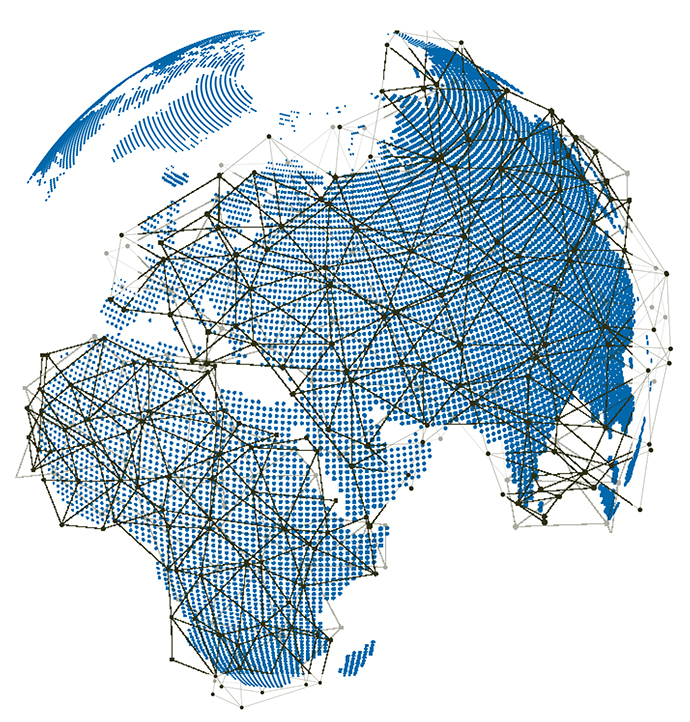
We may not live under the planet Earth in air conditioned cities, but we live under this conceptual crust of cables, satellites and super large computing capabilities connected with each other. Our first robots is our telecommunication network. What would we do without our mobile phone. Would we not be exercising, dieting, playing games with complete strangers across the globe? Would we not monitor our health? Would we not educate ourselves?
What is worrying is the data that has been recorded in those data centres and kept for ever. So, in our crisis the government can use these robots to monitor our movements and controls us.
The second robot is another layer added to this infrastructure. Let’s have give you some clues. We share our inner thoughts, pictures of unborn and born children, our careers and research. We collaborate with our colleagues through these tools. Social media has a double faces that some of us are ignoring. So some predictions were made in 2011 about the potential of analysing the data for political purposes. Now, large companies. just relies in our habits to adapt their activities: Impact of data and data analytics . So, governments and political parties can now manipulate us through social media and we are not even questioning it. At the end of the day, some well-known online shop uses data analytics to predicts our tastes (Fairy worlds and fairy lights). So why not even more darker purpose.
I felt quite outraged about the following: Watchdog approves use of UK phone data to help fight coronavirus . Nonetheless, I believe tracing apps could help, if and only if, it is a democratic choice and not imposed on and some technological measures are in place for not identify its users individually. The latter could be quite challenging and cultural aspects may play a big role in its acceptance; There are many reasons why covid-19 contact-tracing apps may not work. We need to ensure the GDPR , ethical use of data and other legislations are not abused.
This links quite well to my third and fourth robot. Data and modelling. In the last few months, we have been fed by data by units of deaths and coronavirus sufferers : corona virus dashboard and UK dashboard. These data and models validity have yet to be clearly questioned. First of all, units have a apocalyptic effect that are encouraging us to spread the virus. It is a good mediatic method to communicate with the wider population. What about a more refine statistics? What about discussing about the methods of obtaining these data? What about the statistical methodologies used for establishing the lockdown and measures?
These latest robots are more those we need to think of and answer them once the crisis is over.
Shall we become mediavalists?
I could have mentioned 1984 (George Orwell) and Ready Player One. They share some similar themes as the Caves of steel. Now, it is time to perhaps self- reflect in all these questions, while helping with the effort to contains this virus and future pandemic. Staying at home, testing, and tracing are saving lives and reducing our negative impact on the planet. So it is not all negative.
It is perhaps time to become sceptical and consider again our use of technology, data, and validate models used to analyse data. It is worth reviewing how we may be opening ourselves these robots and consider our political choices.
My colleagues will say, I am the biggest sceptical of all; is it just a bad thing?
 Interesting Computing