
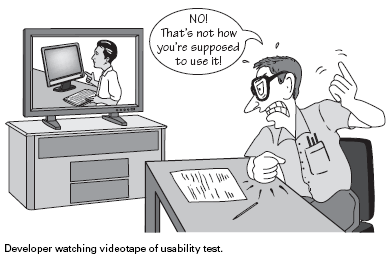
The Interaction design foundation illustrates a common problem to front-end programmers. It is often easier to think our users are at fault. as they do not understand the systems Well, it is not quite correct. Our users need more of our attention. Developers need to pay more attention of the user needs and experience. The issue is that front-end programmers design an interface, not an interaction. If you are wondering what is the difference, then read this outstanding explanation.
- Interaction design determines what’s on the screen and how people use those elements.
- Interface design determines what those elements look like.
This explanation can be quite conservative. Nowadays, our screen have become more than a screen. It has become devices that we can wear or even use as a table. It is interesting that these interactive tables have yet to become part of our lounges. It may be the cost or users have yet to find a use for them. Smart glasses have yet to become mainstream yet. But they are useful in sports like cycling. I am looking forward how Apple Smart glasses will be useful, easy to use or easy to learn.
Don Norman introduced the concept of user experience. This academic was one of the first person to criticise the user interaction with Unix. Some readers may disagree with me; not everybody likes typing command in a command line interface. Try booking some train tickets or some holidays. Before the e-commerce, travel agents had the monopoly to use such systems.
User interaction design requires some different level of skills than the front-end programmer. User interaction is just another form of design that goes side by side with the programming aspect. So, programmers needs to understand it, but not necessarily be good at it. Let’s the designers doing their work.
In one of the project I am currently working, an interface needed to be implemented. While we were all discussing the best solution in term of technological platform, the users were never mentioned. Consequently, I proposed to work with some designers to discuss with our users their need. I could it, but my knowledge of the project is too deep to do a good job.
The experience was interesting. It highlighted the points we need to improve our training; that was a bonus. The main outcome was to discover the interaction requirements. The latter were dictated by the study of user materials, online workshop as well as the user perception of the software.
The Interaction design used many elements of other existing software. Nonetheless, it has bridged the core developing and research team with our users. It has help us understanding their needs. That was invaluable.
This project is a privacy-preserving federated analytical systems. So the design was not affected by social activities, type of devices and physical environment. A better example of innovative user interaction was Pockemon Go. The games has blended the virtual world and real world together. Such extended reality has now been successful in heavy industries and large stock control rooms. The user experience has been outstanding and the games has been adopted rapidly by many people. Social interaction to complete tasks are required and yet they are completed too in such context.
I always struggle to explain what is good design. It is so much easier to focus on the bad one; look at some comparisons. In my mind good design become unnoticed. The user experience is flow less, understand what it does easily and use it over and over again. Otherwise, it becomes a chore and the product remains unused. To reach this level, many iterations of the design is required and the job is never finished. One example is using train ticket machines at railway stations. In the recent years, the design has been improved greatly. In such noisy environment, less attention is required to type your code or book your tickets. This example illustrates well how interaction design can improve user experience.
They are still some areas to address; if I was to study interaction design or attempt to design something interesting I would focus on these issues:
- Motivating people to remain focused on their achievements.
- Assisting people in recommending food suitable for their needs and medical conditions.
- Helping young people to measure their success in learning new skills.
- Smart kitchen that help reducing food waste.
Those are just ideas, many other exists. Remember these ideas focus on design problem. At the heart, these ideas involves some users assisted to complete an activity in a specific physical environment, using an interactive device. If users, activities and physical environments remain undefined, many interactive product will remain unusable. So programmers and designers need to work together.
 Interesting Computing